Manual Input Table+ for AVEVA PI Vision

PI Vision archive editing table for timestamped manual data

Review recorded PI System values and add, correct or delete them in one table on your PI Vision display. Manual Input Table+ collects every change and writes it to PI points or AF attributes when the user saves.

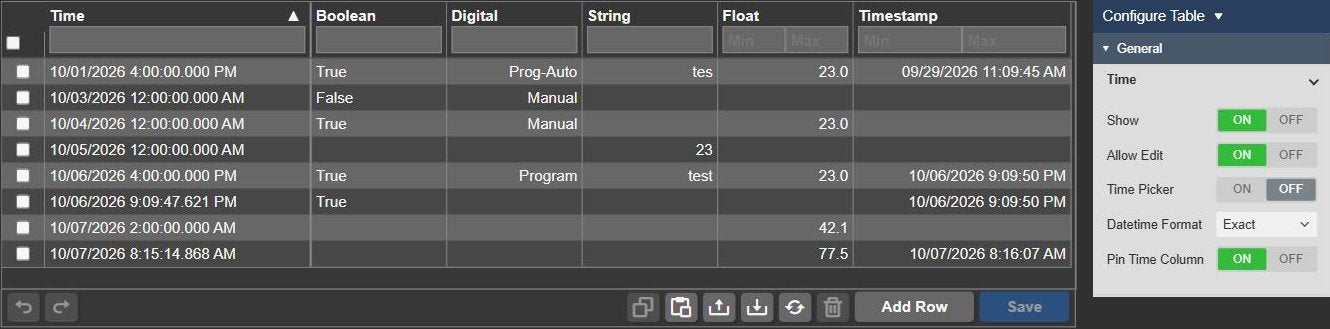
Manual Input Table+ in PI Vision with row tick boxes, a time column and five data source columns of recorded values with filter inputs below the headers, the toolbar with Add Row and an inactive Save button, next to the Time settings with Show, Allow Edit, Time Picker, Datetime Format and Pin Time Column
Manual Input Table+ v2.0 in PI Vision: recorded values of five data sources, one row per timestamp, next to the Time settings. Demo data. Select the image to enlarge.

Edit PI archive data in a PI Vision table

Recorded values and editable rows share one table, so users see the history they are adding to or correcting.

Recorded values of several data sources in one table

Add PI points or AF attributes as columns. Every timestamp becomes one row, with an empty cell where a data source has no value at that time.

  • Time range from the display, a custom start and end, or a duration with an offset.
  • Refresh by hand, at the display’s update interval, or only when archive values change.
  • Column labels, units, alignment and hidden columns, with the time column pinned while the table scrolls.
  • URL values shown as link buttons that open in a new tab.
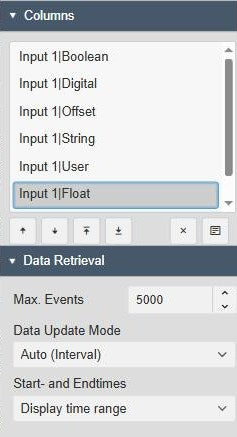
Manual Input Table+ Columns settings with the list of data sources, and the Data Retrieval settings with Max. Events, Data Update Mode Auto (Interval) and Start- and Endtimes set to the display time range
The data sources of one table and how it loads their recorded values. Select the image to enlarge.

Add rows, correct values and delete entries

Users add a row with a prepared timestamp, edit values or timestamps in place, or select rows to delete. Nothing reaches the PI System until they save.

  • Add Row with a default time: now, a fixed time, the display start or end, or relative to the last row.
  • Values and timestamps edited in place; digital states picked from a drop-down list or a dialog.
  • Tick rows to copy or delete them.
  • Undo and redo edits or reload to discard changes; Save or Ctrl+S writes everything together.
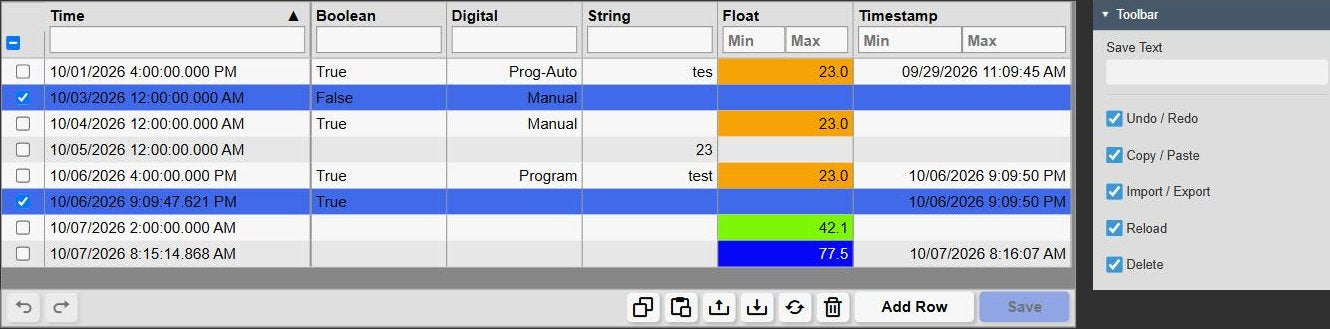
Manual Input Table+ in the Light theme with two rows ticked and highlighted, the toolbar with undo, redo, copy, paste, CSV import, CSV export, reload, delete, Add Row and an inactive Save button, next to the Toolbar settings with Save Text and the Undo / Redo, Copy / Paste, Import / Export, Reload and Delete switches
Two rows selected for copying or deleting; Save stays inactive because nothing was changed. Demo data. Select the image to enlarge.

Bulk manual data entry from Excel and CSV

Bring in many timestamped values at once instead of typing them row by row, then check them before saving.

Paste from Excel or import a CSV file

Copy rows from a spreadsheet and paste them into the table, or upload a CSV file. The new rows appear in the table and are written when the user saves.

  • One timestamp column first, then one column per data source in table order.
  • Skip the time column to stamp pasted or imported rows with the default time.
  • Skip the header row of a CSV file.
  • Copy rows to the clipboard; export CSV from the toolbar, or CSV, JSON, Excel or PDF from the pane.
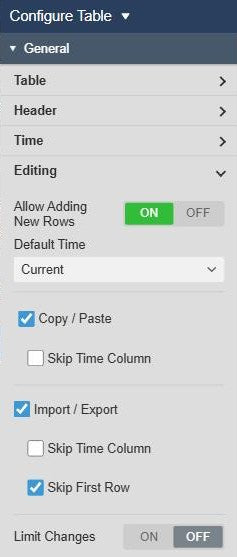
Manual Input Table+ General settings, Editing group, with Allow Adding New Rows on, Default Time Current, Copy / Paste with Skip Time Column, Import / Export with Skip Time Column and Skip First Row, and Limit Changes
Settings for new rows, paste and CSV import. Select the image to enlarge.

Spreadsheet-style selection, filters and paging

Work through long histories the way you would in a spreadsheet.

  • Range selection with row numbers to select and copy blocks of cells.
  • Filter inputs below the headers, with minimum and maximum for numbers and timestamps, and sorting by any column.
  • Paging or scrolling for long tables, and wrapped text for long strings.
  • Right-to-left reading order for right-to-left languages.
Manual Input Table+ with row numbers, a selected cell in the sorted time column, filter inputs with Min and Max boxes below the headers and multi-state colours on one column, next to the Table settings with Layout, Range Selection on, Wrap Text, Right to Left and Paging
Range selection with row numbers, sorting and column filters. Demo data. Select the image to enlarge.

Controlled data entry for PI points and AF attributes

Decide what users may change, catch typing errors and keep values that are already in the archive safe.

Validation limits for numeric values

Check typed numbers against limits, so obvious typing errors do not reach the PI System.

  • Limits from the database (AF Minimum and Maximum traits, or the PI point’s zero and span) or custom limits per column.
  • Prevent Entry Outside Limits blocks the value; otherwise users see a warning and can continue or revert.
  • Limits apply to values typed into numeric columns.
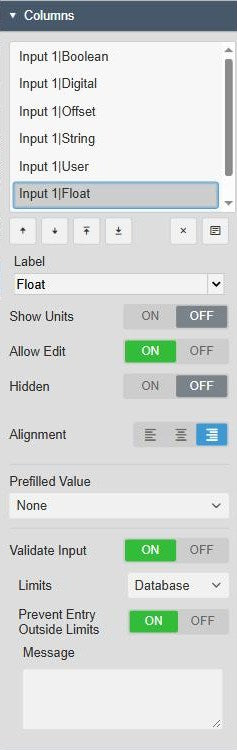
Manual Input Table+ Columns settings for the numeric Float column with Label, Show Units, Allow Edit on, Hidden, Alignment, Prefilled Value None, Validate Input on, Limits Database, Prevent Entry Outside Limits on and a Message box
Database limits that block out-of-range entries for one column. Select the image to enlarge.

Edit rights per column and protection for existing values

Keep reference columns read-only, stop accidental overwrites and make manual values easy to recognise in the archive.

  • Allow Edit per column and for the time column.
  • Protect Existing stops a save that would overwrite a value at the same timestamp.
  • Written values can carry the PI Questionable flag.
  • A string column can be prefilled with the logged-in user name to record who entered a row.
  • The PI point attributes of a column, such as span and step, in a read-only panel.
Manual Input Table+ Columns settings of a digital column with Allow Edit on, Mode Dropdown or Dialog, Hidden, Alignment and Prefilled Value, and the Editing settings with Existing Data Rule and Set Questionable flag on, beside the Point Attributes panel of the PI point behind the Float column
Edit rights and input mode per column, the Existing Data Rule and the Questionable flag, and the PI point attributes of a column. Select the image to enlarge.

Multi-state colours, column groups and table styles

Highlight values outside their normal range and match the table to the rest of the display.

  • Multi-state colours per column as text, border, fill, status dot, value badge or progress bar, with your own thresholds.
  • Column groups by asset, category, description or a custom name.
  • Built-in themes, a custom theme and container styles, applied to one table or to all symbols.
  • PI Vision number formats, and timestamps with or without milliseconds.
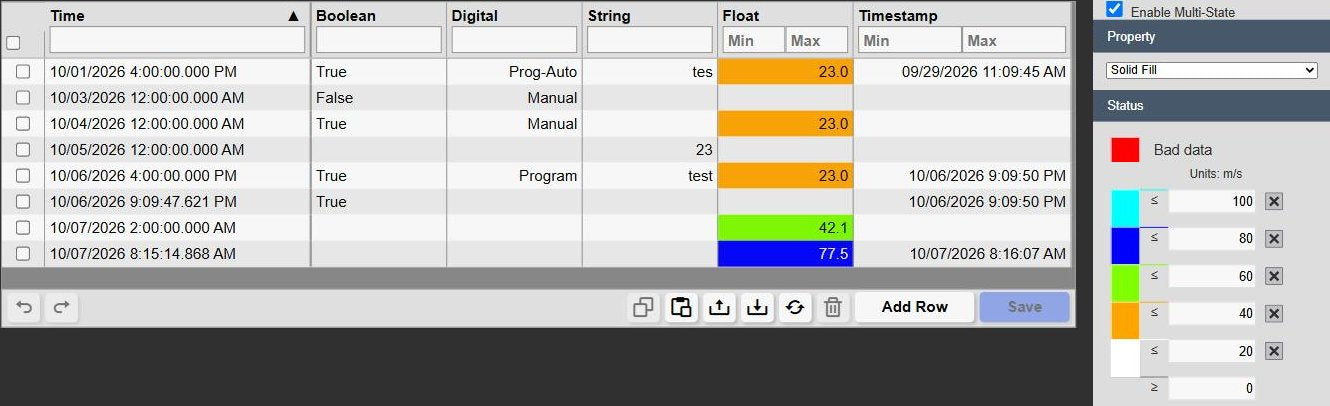
Manual Input Table+ in the Light theme with multi-state fill colours on the Float column, next to the multi-state settings with Enable Multi-State, Property Solid Fill, a Bad data colour and value thresholds
Multi-state fill colours on one column in the Light theme. Demo data. Select the image to enlarge.

PI Vision manual input table examples

Four common ways teams use Manual Input Table+ on their displays.

Lab results

Data
Manual-entry PI points for sample results, with compression off and Step on
Settings
Default time Current, database limits with Prevent Entry Outside Limits
Shows
Lab staff add the day’s results as rows and correct typing errors before saving

Shift readings with the operator name

Data
Field readings plus a string PI point for the operator
Settings
Prefilled Value User on the string column, Allow Edit off for that column
Shows
Each saved row shows the readings and who entered them

Backfill after an outage

Data
Tags of an instrument that was offline
Settings
CSV upload with Skip First Row, Existing Data Rule Protect Existing
Shows
The missing period is filled without overwriting recorded values

Review and correct

Data
Recorded values of a few manual-entry tags over the last week
Settings
Time range duration 7 days, Allow Edit on selected columns, Set Questionable flag
Shows
Corrections are saved with the Questionable flag for later review

Manual Input Table+ FAQ

Questions we are asked most often. Read the Manual Input Table+ documentation or ask a technical question.

Which data entry symbol should I use?

Use Quick Input+ to write one value or action from a single control such as a button, switch, list or slider, without a separate save step. Manual Input Form+ arranges several related fields as a guided form with grouping and validation. Manual Data Entry+ is a straightforward grid for entering values and timestamps for several data sources before saving. Use Manual Input Table+ when users work with history: it shows archived values and lets them add, edit, delete, paste or import timestamped rows. To change the current values of the same attributes on many assets, use Asset Comparison Table+ in Edit mode.

What happens when a user saves?

Edits, new rows, pasted or imported rows and deletions stay in the table until the user clicks Save or presses Ctrl+S; until then, edits can be undone and Reload discards all changes. Save then writes the deletions and the new values to the PI points or AF attributes. With Protect Existing, the save is refused if a value already exists at the same timestamp, and with Set Questionable flag on, the written values are flagged Questionable.

Who can change values, and is it traceable?

Manual Input Table+ writes through PI Web API with each user’s own identity, so PI Data Archive and AF security decide who may write. In the display you choose which columns can be edited, and a string column can record the logged-in user name with each row. Audit trails for archive edits are set up in your PI System, so follow your site’s correction procedure.

How should we prepare the PI points?

Use writable PI points or AF attributes with the right point type and security. Turn off compression on PI points used for manual entry, especially before bulk imports, so no values are discarded, and set Step to On for numeric points so values are not interpolated between entries.

What do we need to run it?

PI Vision 2021 or later with PI Web API, and PI AF Server 2018 SP2 or later. PI Web API must allow writes, and users need write permission on the PI points or AF attributes. Manual Input Table+ runs in PI Vision and uses each user’s existing PI permissions.

How do we get Manual Input Table+?

Manual Input Table+ is part of Vision Library+, together with the other Vision Library+ symbols. Request a trial to test it in your own PI Vision environment.

Try Manual Input Table+ in your PI Vision

Manual Input Table+ is included in Vision Library+, the PI Vision custom symbol library from Software Athlete. Test it on your own displays and data.