Sankey Diagram+ for AVEVA PI Vision

PI Vision Sankey diagram for energy and material flows

See where energy, material or cost goes, from the source to each consumer. Sankey Diagram+ draws PI points and AF attributes as flows between process stages in your PI Vision display, each as wide as its value.

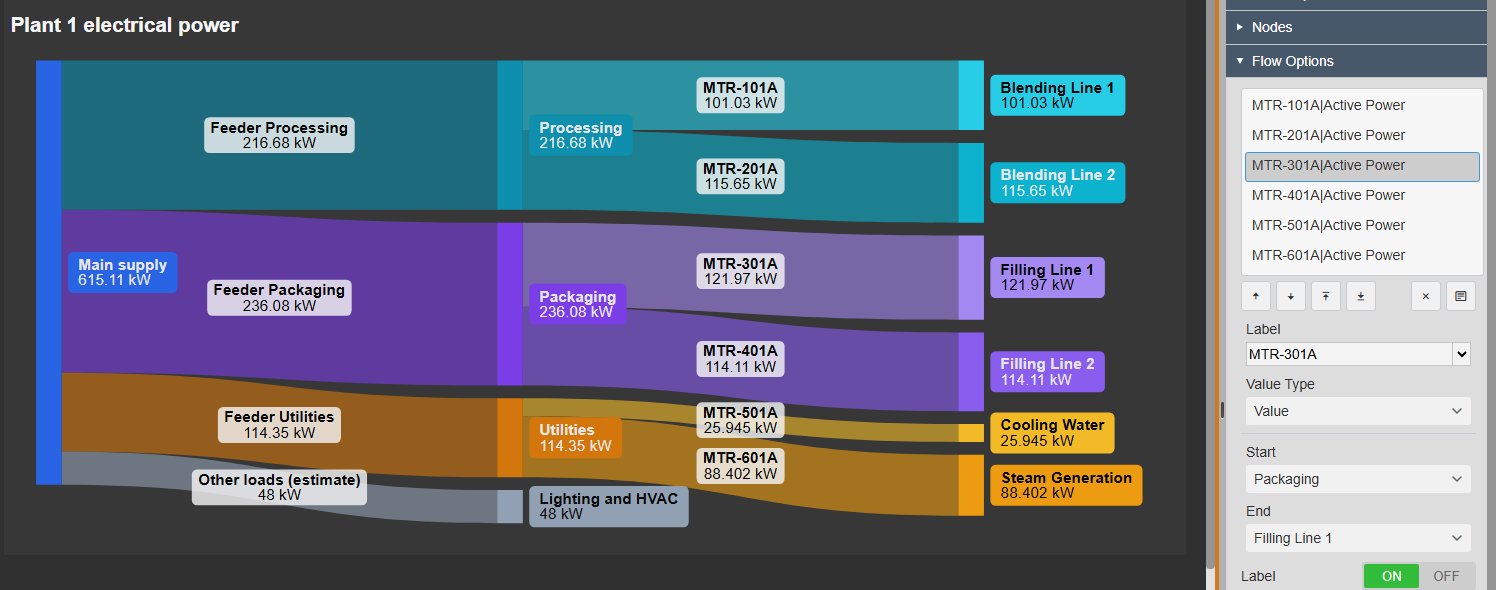
Sankey Diagram+ in PI Vision showing plant electrical power from the main supply through the processing, packaging and utilities feeders to six production lines and systems, each band labelled with its name and value in kW, next to the Flow Options with the flow MTR-301A selected, its value type and its start node Packaging and end node Filling Line 1
Sankey Diagram+ v2.0 in PI Vision: plant power from the main supply to each line, next to the Flow Options. Demo data. Select the image to enlarge.

PI Vision Sankey diagram for live and static flows

Each flow connects a start node to an end node. Live flows read PI data; static flows add fixed values where nothing is measured.

Live flows from PI points and AF attributes

Drag the flow measurements onto the symbol and pick where each one starts and ends. The width of every band follows its value.

  • One flow per PI point or AF attribute, with its own start and end node.
  • Value type per flow: the value, or its average, minimum, maximum, range or standard deviation over the display time range.
  • Flow name from the attribute, element, full path or your own text.
  • Nodes need no data of their own: their size comes from the flows connected to them.
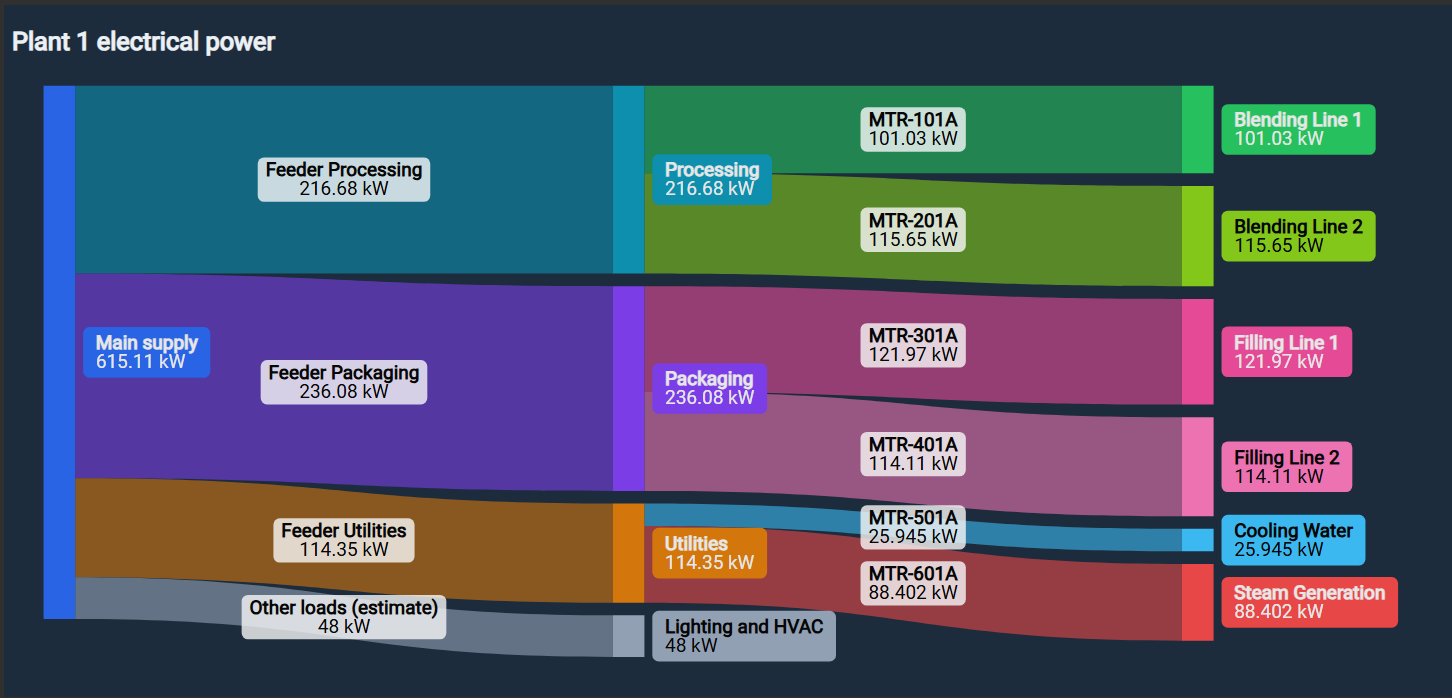
Sankey Diagram+ in the Steel Blue theme with the main supply of 615.11 kW split into processing, packaging, utilities and other loads, and each department split into its lines, with the motor power of each line as a live flow in kW
Live motor power flows from each department to its lines, in the Steel Blue theme. Demo data. Select the image to enlarge.

Static flows for fixed values

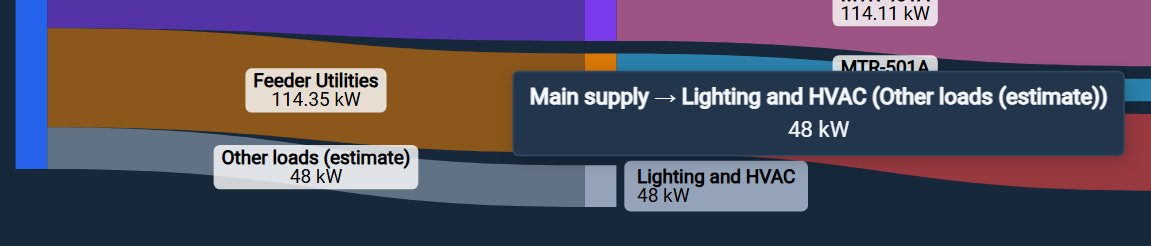
Add a flow with a constant value, for example a design figure or an estimate for a stream that has no meter, and combine it with live flows.

  • Name, value and units per static flow.
  • Start node, end node and colour.
  • Copy a static flow to create similar ones quickly.
  • Label on or off per flow.
Sankey Diagram+ with the tooltip of a static flow reading Main supply to Lighting and HVAC, Other loads (estimate), 48 kW
The tooltip of a static flow for an estimated load. Demo data. Select the image to enlarge.

Click a flow to open its trend

Go from the overview to the history in one click: selecting a live flow opens it in a Quick Trend for the display time range.

  • Quick Trend window titled with the start and end node.
  • Available for every live flow.
  • Hover tooltip with start node, end node, flow name, value and units.
  • Flows with bad data show the system state, such as No Data.
Sankey Diagram+ with a PI Vision Quick Trend window titled Packaging to Filling Line 1, showing the MTR-301A active power of 121.97 kW over the last hour
A Quick Trend opened by clicking a live flow. Demo data (a constant value). Select the image to enlarge.

Sankey diagram nodes, layout and colours

Let the symbol arrange the stages, or place each one where it sits in the process, and colour the flows so the paths are easy to follow.

Automatic or custom node layout

Start with the automatic layout, then move individual nodes when the diagram should mirror the plant.

  • Automatic placement, justified or aligned to the left or right.
  • Custom positions: a column and an order within it for each node, set with an arrow pad.
  • Node width and the distance between nodes from sliders.
  • Horizontal or vertical orientation.
Sankey Diagram+ in the Graphite theme with custom node positions, utilities placed on top and Lighting and HVAC moved to the last column, next to the Nodes settings with Lighting and HVAC selected at position 2, 6 and the arrow pad
Custom node positions, next to the Nodes settings with the position pad. Demo data. Select the image to enlarge.

Colours for nodes and flows

Give every stage its own colour and let the flows take it on, or colour each flow on its own.

  • A colour per node.
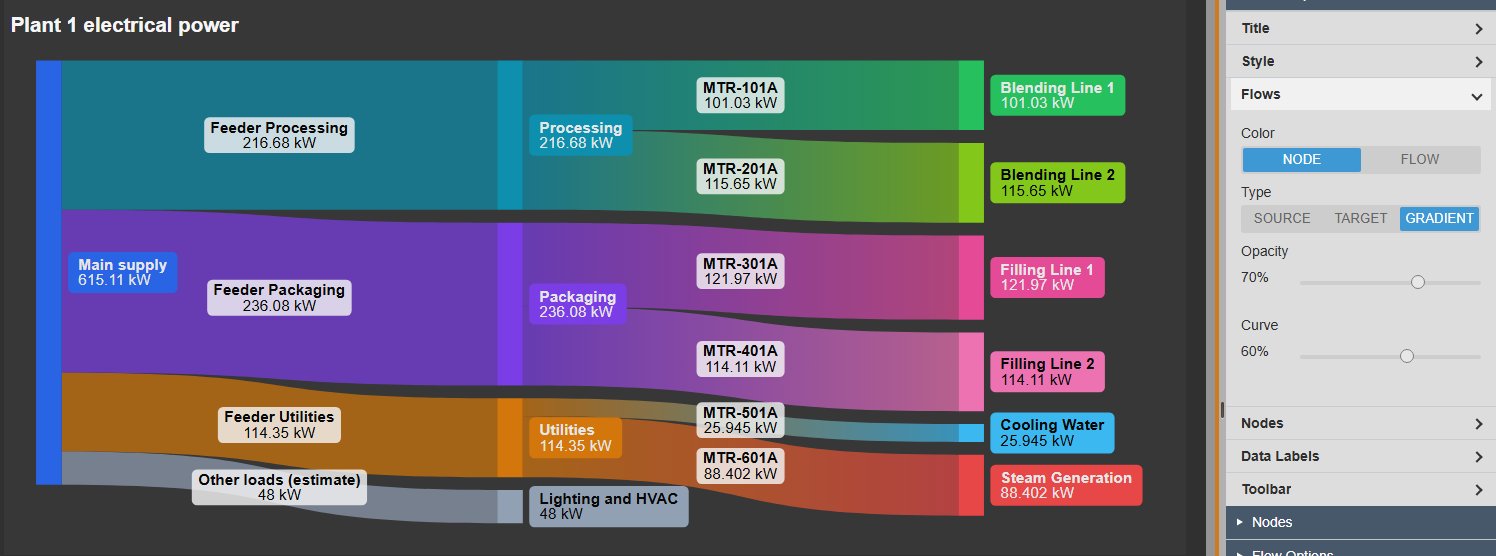
  • Live flows coloured by their start node, their end node or a gradient between both.
  • Or a colour per live flow; static flows keep their own colour.
  • Flow opacity and curvature from sliders.
Sankey Diagram+ with flows shaded in a gradient from the colour of their start node to the colour of their end node, next to the Flows settings with colour by node, type gradient, opacity and curve sliders
Gradient flow colours, next to the Flows settings. Demo data. Select the image to enlarge.

Sankey labels, themes and export

Put the numbers on the diagram, match it to the display, and take the view or its data with you.

Node and flow labels with values and units

Read every stage and every flow without hovering.

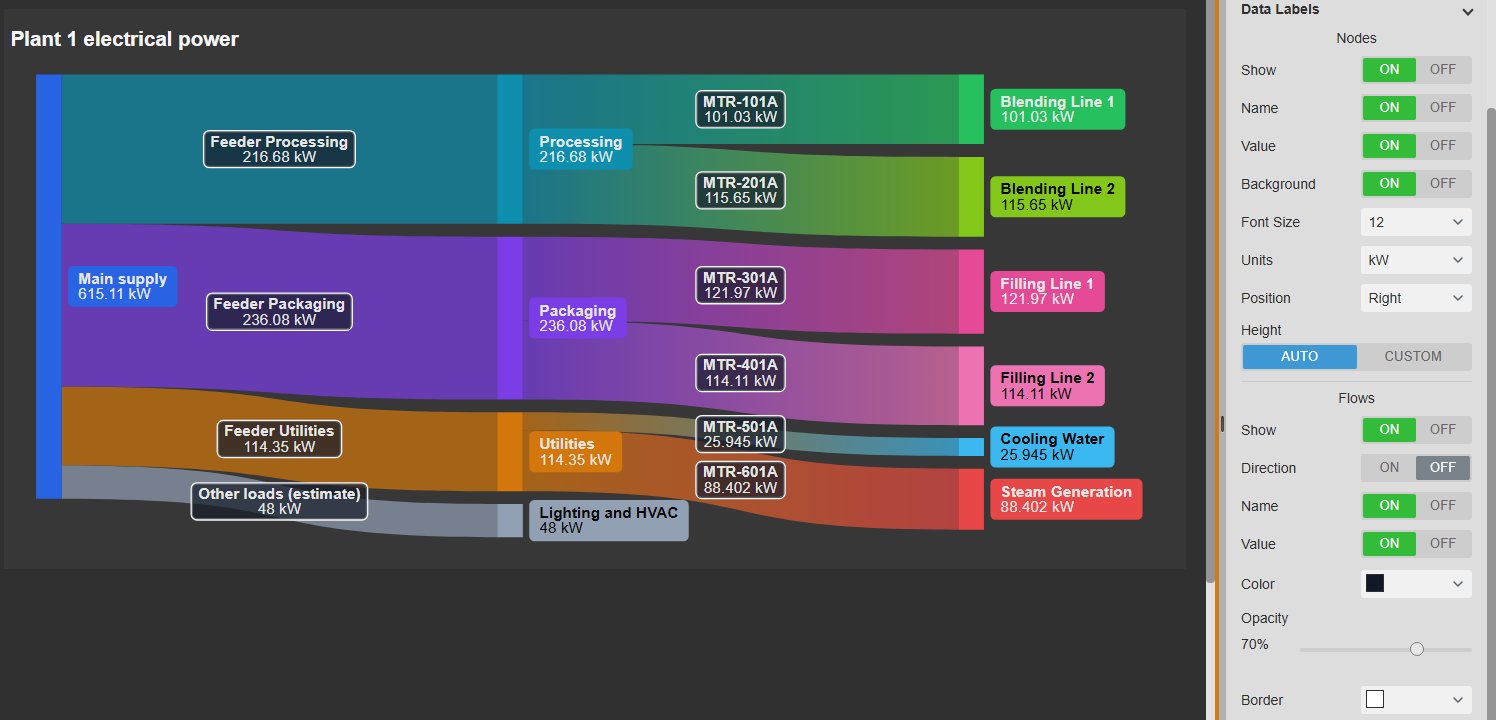
  • Node labels with name, value and units, left, right, inside, above or below the node.
  • Flow labels with name and value, on a background with its own colour, opacity and border.
  • Optional direction arrows on the flows.
  • Labels on or off per node and per flow, with font size and one number format.
Sankey Diagram+ with node labels showing name and value in kW to the right of each node and flow labels on dark backgrounds with a white border, next to the Data Labels settings for nodes and flows
Node labels and dark flow labels, next to the Data Labels settings. Demo data. Select the image to enlarge.

Themes, containers and titles

Match the diagram to the display with a built-in theme, or set the colours yourself.

  • Nine built-in themes, including Light, Print and High Contrast, plus custom colours.
  • Flat or gradient surface, and a None, Flat, Card, Framed or Glass container.
  • Apply the style to every Vision Library+ symbol on the display in one step.
  • Title and subtitle with alignment and font size.
Sankey Diagram+ in the Light theme with a card container on a dark PI Vision display, with a title and subtitle, next to the Style settings with the theme grid, surface, container style and the Apply to all symbols button
Light theme with a card container, next to the Style settings. Demo data. Select the image to enlarge.

Full screen and download

Open the diagram larger, or save it as an image or as flow data for a report.

  • Toolbar on hover, or always shown.
  • Full screen without requesting the data again.
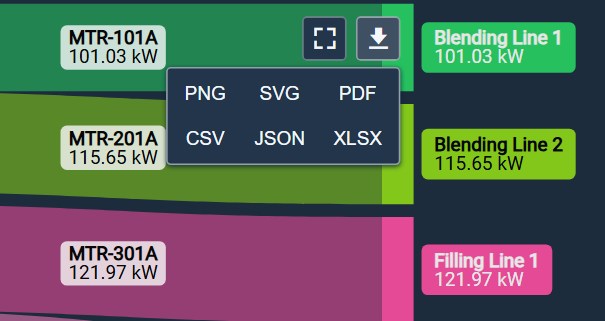
  • Download as PNG, SVG or PDF.
  • Flow data as CSV, JSON or XLSX: start, end, flow, value and units per flow.
Sankey Diagram+ toolbar with the download menu open, offering PNG, SVG and PDF images and CSV, JSON and XLSX data
The download menu on the toolbar. Demo data. Select the image to enlarge.

PI Vision Sankey diagram examples

Four common ways teams use Sankey Diagram+ on their displays.

Site energy balance

Data
Metered energy from the supply to each area and consumer
Settings
Supply, areas and consumers as nodes, flows coloured by their end node
Shows
Where the energy goes and which consumer takes the most

Steam or utility distribution

Data
Boiler or header output and the flow to each user
Settings
Live flows per user, a static flow for an estimated unmetered loss
Shows
How the utility splits across users and how much is unaccounted for

Water or wastewater treatment

Data
Flows between treatment stages, recycle excluded
Settings
Custom node positions that follow the process, direction arrows on
Shows
How much water passes each stage and where it leaves the process

Feed and product yield

Data
Feed rate and the rates of each product or by-product
Settings
Value type Average over the display time range, labels with units
Shows
How the feed divided into products over the shift

Sankey Diagram+ FAQ

Questions we are asked most often. Read the Sankey Diagram+ documentation or ask a technical question.

When should I use a Sankey diagram in PI Vision?

Use Sankey Diagram+ when the question is how a total divides between process stages and how large each flow is, for example energy from the supply to each consumer. When only the connections matter and not the size of the flows, a standard process graphic is easier to read.

Does every flow need its own PI point or AF attribute?

A live flow reads one PI point or AF attribute. For streams that are not measured, add a static flow with a fixed value, such as a design figure or an estimate, and give it its own start and end node.

How are the node values calculated?

Nodes have no data source of their own. Each node shows the larger of its incoming and outgoing totals. If the flows into and out of a stage differ, for example because a loss is not metered, add the difference as its own flow so the diagram balances.

Can the diagram show recycle streams or loops?

No. Sankey Diagram+ does not support cyclical flows. A flow that would close a loop is not drawn, and the symbol shows a warning. Map the recycle as a separate end node instead.

What do we need to run it?

PI Vision 2021 or later with PI Web API, and PI AF Server 2018 SP2 or later. Sankey Diagram+ runs in PI Vision and uses each user’s existing PI permissions.

How do we get Sankey Diagram+?

Sankey Diagram+ is part of Vision Library+, together with the other Vision Library+ symbols. Request a trial to test it in your own PI Vision environment.

Try Sankey Diagram+ in your PI Vision

Sankey Diagram+ is included in Vision Library+, the PI Vision custom symbol library from Software Athlete. Test it on your own displays and data.