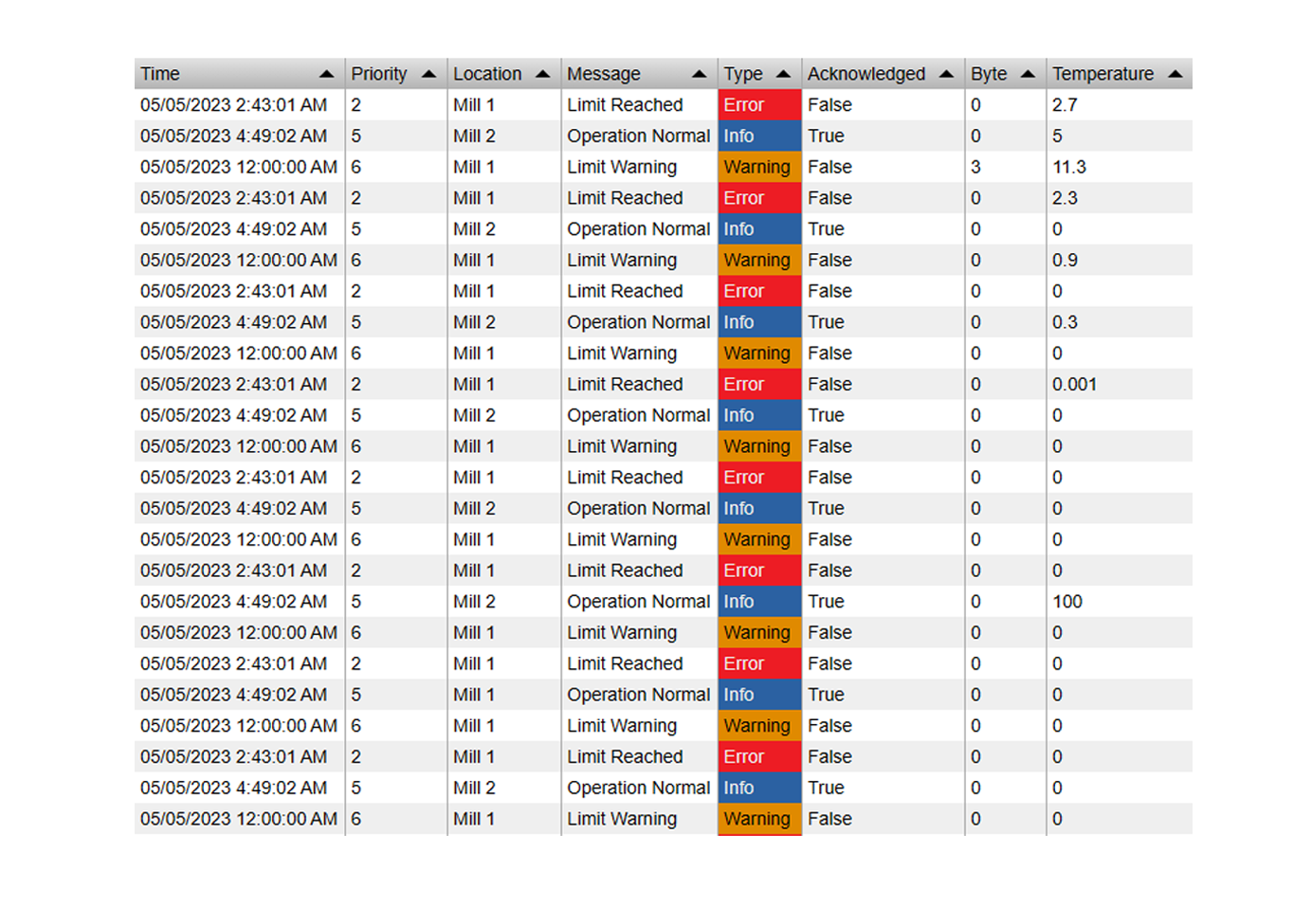

Native AVEVA PI Vision is a strong foundation for real-time visualization, self-service dashboards, and ad hoc analysis. Vision Suite Ultimate becomes valuable when teams want that same PI Vision workspace to support richer operational dashboards, structured data entry, Event Frame workflows, automated reports, and display governance.
Start with the foundation
What native AVEVA PI Vision already does well
AVEVA describes PI Vision as a web-based display and dashboard-building tool for operational data. Its native strengths include reusable self-service displays, drag-and-drop authoring, real-time and historical trends, asset context, Event Frame information, ad hoc analysis, visual alarm behaviors, and browser-based sharing.
For many monitoring scenarios, that is exactly what a team needs. A clear equipment overview, a process trend, a multi-state status display, or a reusable AF-based dashboard may not require any extension at all.
Visualize operations
Create browser-based process displays from PI points, AF attributes, calculations, and events.
Investigate quickly
Use trends, ad hoc analysis, time navigation, and Event Frame context to explore operating behavior.
Standardize displays
Build reusable dashboards that make trusted PI System data available across roles and devices.
A credible upgrade case starts here: keep the native capabilities that work. Add Vision Suite Ultimate only where users otherwise depend on spreadsheets, screenshots, separate input tools, custom workarounds, or manual display administration.
Side-by-side comparison
Native PI Vision vs. Vision Suite Ultimate
The suite is best understood as an operational layer around the native PI Vision foundation. It broadens what users can see, do, share, and govern without turning the dashboard into a separate application.
| Workflow | Native PI Vision focus | What Vision Suite Ultimate adds | Operational outcome |
|---|---|---|---|
| Dashboard visualization | Core trends, values, gauges, tables, shapes, multi-state behavior, and reusable displays | Advanced charts, KPI controls, maps, navigation, asset selection, contextual popups, and specialized symbols | More decision-ready dashboards with fewer visual workarounds |
| Ad hoc investigation | On-the-fly trending, calculations, time navigation, and event comparison | Additional analysis patterns such as box plots, histograms, period comparison, Pareto-style views, and configurable drill-down controls | More analysis remains inside the PI Vision workflow |
| Operator input | Primarily visualization and analysis of PI System data | Manual Data Entry+, input tables, quick inputs, forms, notes, reason codes, and configurable writeback workflows | Readings and operational context can be captured beside the data they explain |
| Event Frame workflows | Events tables, event details, event comparison, acknowledgement, and comments | Interactive event tables, filters, timelines, Gantt views, aggregation, categorization, and workflow-oriented event analysis | Downtime, batch, and incident review becomes more structured |
| Reporting | Interactive browser displays with manual sharing, capture, or print workflows | Scheduled and event-triggered PDF/image reports, email delivery, printing, storage, and report history through Vision Report+ | Shift, batch, downtime, and management reporting becomes repeatable |
| Display governance | Display creation, sharing, administration, and native management capabilities | Version history, change reasons, comparison, rollback, deleted-display recovery, validation states, notifications, and audit trail through Vision Audit+ | Critical dashboards become traceable and recoverable |

From dashboards to workflows
What Vision Suite Ultimate adds to daily PI Vision use
Vision Suite Ultimate combines the capabilities of Vision Library+, Vision Report+, and Vision Audit+. Together, they support four connected stages of operational work.
Build decision-ready dashboards
Use advanced charts, KPI components, asset comparison, maps, navigation, alarms, Event Frame views, and interactive controls to make the display match the operational question.
Capture data and context
Record readings, laboratory values, notes, reason codes, and shift context directly from the PI Vision workflow with configurable data-entry controls.
Automate repeatable reports
Turn existing PI Vision displays into scheduled or event-triggered PDF and image reports, then email, print, store, and review the generated output.
Protect critical displays
Track versions and change reasons, compare revisions, restore previous states, recover deleted displays, and support validation-oriented review processes.


A connected operating model
The bigger gain is continuity between tasks
A single advanced chart can be useful, but the larger value appears when the workflow stays connected: a user sees a condition, investigates its history, records context, shares a report, and trusts that the underlying display is controlled.

Choosing the right scope
When is native PI Vision enough—and when should you upgrade?
Keep the standard foundation
- Your primary need is real-time visualization and straightforward monitoring.
- Native trends, values, gauges, tables, events, and ad hoc analysis cover the use case.
- Reporting, input, and display change control already have acceptable processes elsewhere.
- Users are not repeatedly exporting data or recreating the same workaround.
Extend recurring operational workflows
- Operators need to enter readings, notes, reason codes, or corrections in context.
- Engineers require richer visualization, navigation, Event Frame analysis, or reusable dashboard controls.
- Teams manually create recurring reports from screenshots, exports, or spreadsheets.
- Critical displays require version history, rollback, recovery, validation, or an audit trail.
You do not need to extend every display. Start with the workflows that consume the most time, carry the most operational risk, or create the most repeated manual work.
A practical adoption path
How to evaluate Vision Suite Ultimate without overengineering
Choose one recurring workflow
Select a dashboard with a clear operational gap—such as data entry, downtime investigation, shift reporting, or display recovery.
Measure the current effort
Document the spreadsheets, screenshots, handoffs, manual steps, failure modes, and support burden surrounding the native display.
Configure the smallest useful extension
Use the native PI Vision capability first, then add only the Library+, Report+, or Audit+ functions required for the outcome.
Validate with the actual users
Confirm that operators, engineers, and administrators can complete the real workflow—not merely that the new dashboard looks better.
Frequently asked questions
Native PI Vision and Vision Suite Ultimate FAQ
Does Vision Suite Ultimate replace AVEVA PI Vision?
No. Vision Suite Ultimate extends AVEVA PI Vision. Native PI Vision remains the visualization and dashboard foundation, while the suite adds configurable operational, reporting, and governance capabilities.
Do we need to rebuild our existing PI Vision displays?
Not necessarily. Vision Report+ can work with existing displays, Vision Audit+ protects and tracks displays, and Vision Library+ controls can be added where a dashboard requires richer interaction or visualization. The right scope depends on the workflow.
Is Vision Suite Ultimate only a custom-symbol package?
No. Custom symbols and controls are one part of the suite. It also covers structured operator input, automated PDF and image reporting, scheduling and delivery, display version history, rollback, deleted-display recovery, validation states, and audit-oriented workflows.
Can we start with one use case or product module?
Yes. A focused pilot is usually the most practical evaluation. Start with a representative workflow and confirm the licensing and deployment scope that fits your environment with Software Athlete.
How do we decide whether the upgrade is worth it?
Compare the current time and risk associated with manual entry, spreadsheet workarounds, report preparation, repeated custom development, and display recovery against the value of a supported, repeatable PI Vision-centered workflow.
Bring one real PI Vision workflow
See what Vision Suite Ultimate would change in your environment
Show us the dashboard, report, input process, or governance requirement your team is working around today. We can map the native foundation, the smallest useful extension, and a practical evaluation path.